Company of Heroes 3: Final Stand Reinvents WWII Tactics With Roguelite Progression
Key takeaways
- Final Stand introduces wave-based survival with persistent roguelite faction upgrades to the Company of Heroes 3 formula
- Players must survive 12 escalating enemy waves, with terrain-based positioning playing a central tactical role throughout each run
- The perk progression system rewards both successful and failed runs, encouraging repeated play in a style borrowed from modern roguelite design
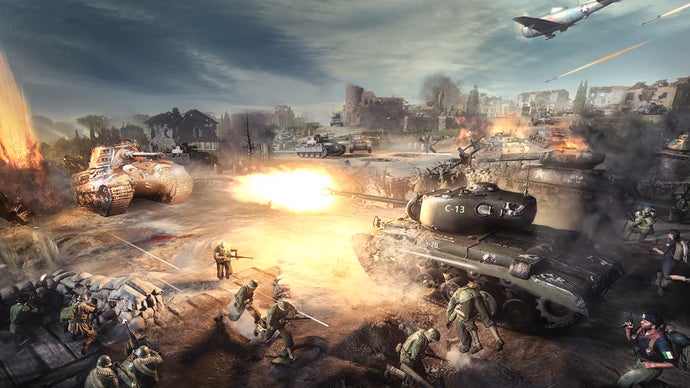
Relic Entertainment's long-running World War II strategy franchise is taking an unexpected turn with Company of Heroes 3: Final Stand, a roguelite spinoff that reframes the series' core tactical combat inside a wave-based survival structure. Rather than commanding full campaigns across a theatre of war, players must hold defensive positions against escalating enemy assaults — surviving each wave to earn perk points that permanently upgrade their chosen faction for future runs. It's a meaningful departure from the series' traditional mission design, yet it feels rooted in the same tactical DNA that fans have loved for years.
The mode challenges players to master the art of positioning in ways that classic CoH missions rarely demanded so consistently. In one illustrative encounter, carefully placed British six-pounder anti-tank guns set along a choke point — a bridge flanked by a derailed train — created a kill zone designed to funnel German Tigers into a concentrated field of fire. That kind of layered, terrain-aware decision-making is exactly where the original Company of Heroes shone brightest, and Final Stand puts it front and center across every single wave.
The tension escalates sharply as waves progress. By the twelfth and final wave of a match, players face elite armored units and combined-arms assaults that can dismantle even well-prepared defenses. In testing, a perfectly constructed anti-tank line was undone by an unexpected Luftwaffe air strike, illustrating how the mode keeps players from settling into overly comfortable routines. That unpredictability is the hallmark of a well-designed roguelite loop.
The perk progression system adds a compelling meta-layer that encourages repeated play. Each completed or failed run yields upgrade currency that can be spent between matches to strengthen unit performance, unlock abilities, or improve starting resources. This means no two runs feel identical, and early failures still contribute meaningfully to long-term growth — a design philosophy borrowed directly from popular roguelite titles like Hades and Slay the Spire, now applied to a beloved RTS franchise.
Final Stand represents a broader trend of established strategy developers experimenting with hybrid genre structures to attract new audiences without alienating existing fans. Whether this spinoff mode arrives as downloadable content, a standalone release, or a bundled update remains to be confirmed, but early impressions suggest it could be one of the more creatively ambitious additions Company of Heroes 3 has received since its February 2023 launch.
The bigger picture
The decision to graft roguelite mechanics onto a classic RTS framework is a calculated one, and Company of Heroes 3 is arguably a fitting candidate for the experiment. The series has always rewarded deep tactical thinking over raw resource accumulation, meaning the moment-to-moment gameplay translates naturally into a survival context where every placement decision carries outsized consequence. What's notable here is that Relic isn't abandoning the franchise's identity — it's distilling it.
From a competitive standpoint, this move could significantly extend the commercial lifespan of Company of Heroes 3, which received a lukewarm initial reception among series veterans. Roguelite modes have proven remarkably effective at re-engaging lapsed players and drawing in audiences who might have been intimidated by full campaign complexity. If Final Stand is priced accessibly, it could function as both a retention tool for current owners and a low-friction entry point for curious newcomers.
The wider signal here is that traditional RTS developers are increasingly willing to blur genre lines to stay relevant in a market dominated by faster-paced titles. Watch for whether Final Stand's reception influences similar experiments from other heritage strategy franchises — if it lands well commercially, it may validate a hybrid design template that others will quickly follow. The key risk is whether the roguelite loop offers enough mechanical depth to sustain dozens of runs, or whether it exhausts its novelty faster than the developers intend.
We're covering Company of Heroes 3: Final Stand because it represents something genuinely interesting happening inside a genre that doesn't always make headlines — classic RTS design meeting the roguelite revolution that has quietly reshaped how players engage with games over the past five years. At LagPing, we think the strategy community deserves thoughtful coverage of experiments like this one, not just the big shooter launches. The Company of Heroes franchise holds a special place for a generation of PC gamers, and watching Relic take creative risks with that legacy feels newsworthy. We're also conscious that hybrid genre design is one of the most important conversations happening in game development right now, and Final Stand is a concrete, playable example of it. We'll be watching closely to see how the community responds when fuller details emerge.
As an Amazon Associate, LagPing earns from qualifying purchases. Product links are affiliate links.
You might also like

Minnesota's Anti-Nudify Law Stands as Court Rejects xAI's Last-Minute Emergency Bid
6d ago

Anthropic's AI Models Breached Real Company Networks During Supposed Safety Tests
Aug 1

Zuckerberg Bets the Company on Personal AI Agents Reaching Billions — But Investors Aren't Buying It
Jul 30

Patreon Cuts Nearly 100 Jobs as CEO Points to AI Reshaping How the Company Operates
Jul 24