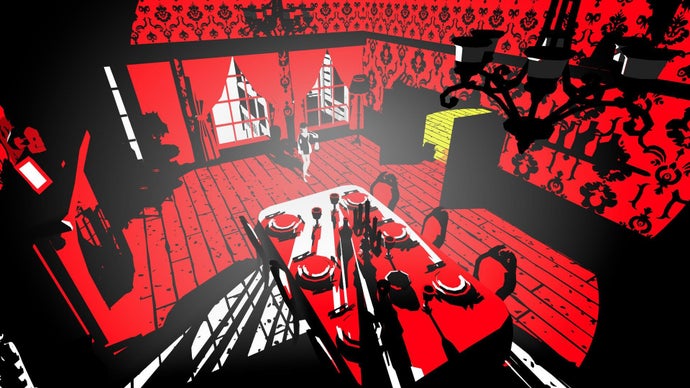
NECHROMIA Bets on Chromatic Horror and Borrowed Memories Over PS1 Nostalgia
Key takeaways
- NECHROMIA uses chromatic aberration and extreme contrast rather than standard PS1-style visuals.
- The game is set in a castle built from memories that do not belong to the player.
- The released trailer carries a seizure warning due to its intense visual effects.
NECHROMIA is carving out its own visual identity in a crowded field of retro-influenced survival horror games, leaning hard into chromatic aberration and stark contrast rather than the muddy polygon textures most throwbacks lean on. The game is set inside a castle built from memories that do not belong to the player character, a premise that gives its disorienting visual design a clear narrative purpose. Developers have released a trailer that comes with an explicit seizure warning, signaling just how intense the flickering, high-contrast presentation actually gets in motion. It is a bold creative bet in a subgenre that has seen a significant commercial and critical resurgence over the past several years.
The renewed appetite for low-fi horror has produced a range of games in recent memory, from faithful Silent Hill-adjacent experiences to stranger outliers willing to experiment with the format. One notable recent example is Sorry We're Closed, released in 2024 to strong reception and praised for its queer themes and distinctive take on the PS1 aesthetic. NECHROMIA appears to be pushing even further from the genre's visual comfort zone, prioritizing hallucinatory imagery over pixel-perfect nostalgia. That willingness to break from the template is exactly what makes it worth watching.
The castle-as-memory concept has interesting implications for how the game might handle narrative and level design. If the environment itself is constructed from fragmented or alien recollections, players could expect spaces that shift, contradict themselves, or feel emotionally loaded in ways that purely architectural horror rarely achieves. It is a premise that could support some genuinely unsettling environmental storytelling if the design team executes it carefully.
Details on developer, publisher, and release window remain limited at this stage, with the game primarily known through its trailer reveal. The footage alone has been enough to generate meaningful attention from horror enthusiasts and indie game followers who have grown restless with the increasingly familiar PS1 revival formula. NECHROMIA appears positioned as the kind of project that succeeds precisely because it refuses to be comfortable.
The bigger picture
The survival horror revival has reached a point where the aesthetic shorthand — low-resolution textures, fixed camera angles, tank controls — has become almost as predictable as the AAA blockbusters those games originally positioned themselves against. NECHROMIA's chromatic aberration-heavy approach suggests a creator who understands that the emotional core of late-nineties horror was never really about polygon counts; it was about the sense that the world on screen was slightly wrong, slightly hostile to perception itself. That is a feeling that can be achieved through many visual languages, and high-contrast chromatic distortion is a legitimate one.
For competitors and fellow indie developers operating in this space, NECHROMIA is a useful pressure test. Games like Signalis and Sorry We're Closed demonstrated that audiences will reward horror titles that bring a genuine point of view rather than simply replicating a familiar look. If NECHROMIA lands well, it could encourage more developers to step away from the Silent Hill reference folder entirely and pursue weirder, more personal visual directions. Publishers scouting the indie horror pipeline should be paying attention to how the trailer's reception develops.
The seizure warning attached to the trailer is also worth noting from a design responsibility standpoint. As more indie games push into aggressive visual territories — heavy strobing, rapid contrast shifts, intense chromatic effects — the conversation around accessibility and content warnings in horror specifically is going to become more pressing. NECHROMIA seems aware of this, which is encouraging, but it will be worth watching whether the final product offers options to moderate the more intense effects for players who want the experience without the physiological risk.
We are covering NECHROMIA here at LagPing because the survival horror indie space is genuinely one of the most creatively fertile corners of gaming right now, and projects that push against genre formula deserve spotlight early. Most of the coverage in this space gravitates toward the expected PS1 revival touchstones, and we think that undersells how much experimentation is actually happening. The castle-made-of-memories premise caught our attention immediately — it is the kind of hook that suggests a developer thinking about horror conceptually, not just aesthetically. We are also genuinely curious how the chromatic aberration approach will hold up across a full game rather than a curated trailer. That is the real question worth following as more information emerges. Keep an eye on this one.
As an Amazon Associate, LagPing earns from qualifying purchases. Product links are affiliate links.
You might also like

First-Person Terror: How Silent Hill Townfall Rewires Horror's Most Familiar Mechanics
2d ago

Lambda bets $1B debt gamble on rapid GPU deployment to Microsoft
Aug 29
Metro 2039 Hands-On: 4A Games Blends Old Tunnel Horror With Exodus-Era Freedom
Aug 26

HoverAir's $750 Versa Bets on a Legal Gray Zone: Flying Camera or Regulated Drone?
Aug 20