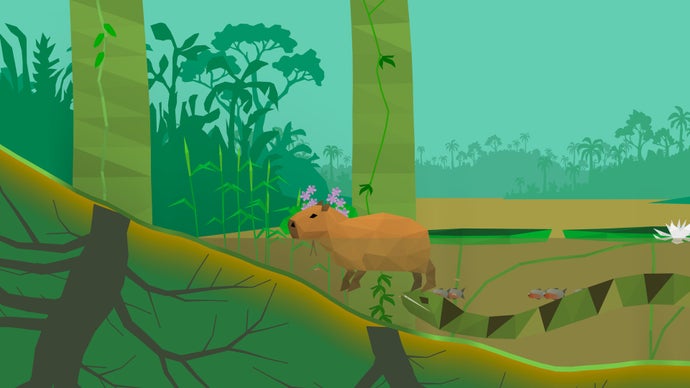
Polyzonia Wants You to Rebuild the Amazon One Capybara at a Time
Key takeaways
- Polyzonia is a click-driven Amazon rainforest ecosystem sim with no confirmed release date, currently on Steam wishlist.
- Players seed plant and animal life manually, with the goal of building a self-sustaining environment through automation.
- Developer Cloudberry Pine emphasizes that organisms actively interact with the world rather than serving as passive decoration.
Cloudberry Pine has revealed Polyzonia, an ecosystem simulation game set in the Amazon rainforest, currently available to wishlist on Steam with no confirmed release date attached. The title tasks players with seeding an environment from scratch — selecting a biome, planting vegetation, and eventually introducing animals — until the whole system can run without constant input. It's a patient, deliberate kind of game, and one that's already generating quiet buzz for its unusual tone.
The core loop shown in the trailer is deeply click-driven and granular. Players start by placing plant life across a chosen biome, then layer in fauna once enough vegetation is established. From there, you're nudging animals through their daily routines — clicking a capybara so it can relieve itself, then directing a jaguar toward its next meal. The food chain is very much alive here, and the developers appear to have leaned into that with intention rather than squeamishness.
Polyzonia also allows for a micro-level focus that sets it apart from broader god-game comparisons. Individual flowers can be pollinated by hand, and players can prompt frog spawn clinging to a branch to drop into a river and begin its transformation into a tadpole. These small moments feed into the larger goal: an ecosystem eventually capable of sustaining and developing entirely on its own through automation.
Cloudberry Pine has been careful to draw a distinction between Polyzonia and more detached simulation titles. The Steam page explicitly states that "plants and animals are not decorations, they interact with the world around them and you can influence them." That framing suggests the studio wants players to feel genuine agency over living systems, not just arrange scenery.
The closest comparison point the trailer invites is early Spore — specifically the sense of nurturing something from nothing, building complexity piece by piece. Whether Polyzonia can deliver a sustained experience beyond that initial wonder remains the open question, but the premise alone is enough to earn it a spot on a lot of wishlists.
The bigger picture
Ecosystem and nature sims occupy a narrow but loyal corner of the gaming market, and Polyzonia is arriving at a moment when players are increasingly drawn to slower, more contemplative experiences. Titles like Eco and Alba: A Wildlife Adventure have proven that environmental themes don't need to be wrapped in anxiety mechanics to find an audience — Cloudberry Pine seems to be threading a similar needle, prioritizing curiosity over crisis.
The competitive landscape here is relatively sparse, which is both an opportunity and a risk. Without a clear genre leader to benchmark against, Polyzonia has room to define its own expectations — but it also means Cloudberry Pine will need to do substantial work communicating what the game actually feels like to play beyond its trailer highlights. The automation element, where the rainforest eventually self-sustains, is the most interesting design hook: it implies a natural endpoint to the experience, which most sandbox sims deliberately avoid. How the studio handles player engagement once the ecosystem no longer needs them will be the real test.
For platform holders and storefronts, titles like this also matter as catalog diversifiers. Steam in particular has invested in surfacing quieter indie experiences, and a well-executed Amazon rainforest sim could attract both the nature documentary crowd and lapsed gamers looking for something without a battle pass. Watch for how Cloudberry Pine handles early access timing — releasing too early with thin content could undercut the very sense of living richness the game is selling.
We're covering Polyzonia because it represents something genuinely rare in the ecosystem sim space: a game that seems to care about the ethics of how we represent living creatures on screen, not just the aesthetics. The question the writer raises — whether games create a harmful distance between players and the animals they control — is one we don't see asked often enough, and it's one that Polyzonia appears to be actively wrestling with in its design. We also think the Amazon rainforest setting carries real-world weight that most sim backdrops don't. Whether or not Cloudberry Pine fully delivers on that promise, the conversation the game is starting feels worthwhile. We'll be watching its development closely and will update readers once a release window is confirmed.
As an Amazon Associate, LagPing earns from qualifying purchases. Product links are affiliate links.
You might also like

Amazon's $20M Water Pledge Raises Questions About Data Center Transparency
2d ago

Spiel des Jahres Winner Hits Record Low on Amazon After Year of Sellouts
Sep 9

Pokémon Destined Rivals Box Drops Below Scalper Prices on Amazon
Sep 8

Boeing 767 Overruns Runway at Miami Hub, Injures Multiple in Amazon Logistics Operation
Sep 7