Red Echoes: Berlin Puts You in the Heart of Germany's 1918 Revolution
Key takeaways
- Red Echoes: Berlin is a narrative turn-based strategy game set during Germany's November Revolution of 1918–1919
- Players control three different agitators across three chapters, interacting with real historical figures like Rosa Luxemburg and Karl Liebknecht
- The game features a Weimar-era inspired visual style and tactical map-based gameplay reminiscent of the political strategy title Suzerain
A new turn-based strategy game is emerging from the history books, thrusting players directly into one of the most volatile political upheavals of the 20th century. Red Echoes: Berlin drops players into Germany's November Revolution, spanning the chaotic final months of World War 1 and the bloody, uncertain dawn of a new republic. The game unfolds across three chapters, each following a different protagonist drawn from varied social backgrounds, all united by a single burning cause: toppling the Kaiser and reshaping German society from the ground up.
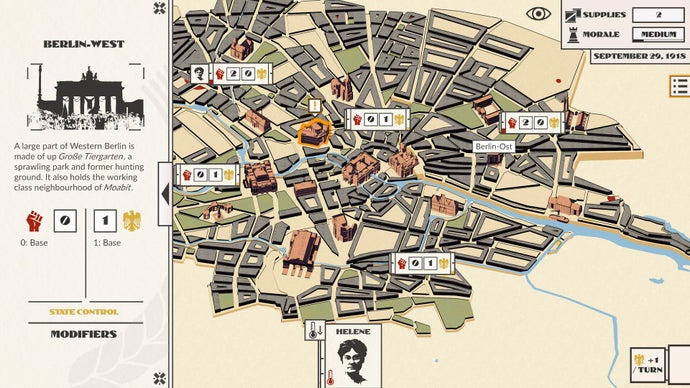
The gameplay blends narrative depth with tactical decision-making in a style that will feel familiar to fans of Suzerain, the acclaimed political strategy title that challenged players to govern a nation through morally complex choices. In Red Echoes: Berlin, players move their cast of agitators across a meticulously crafted map of the German capital, deploying each character's unique special abilities to outmaneuver the forces of the imperial state. The map itself is a visual centerpiece, drawing heavily from authentic Weimar-era graphic design to create an aesthetic that feels both historically grounded and artistically striking.
Historical figures loom large throughout the experience. Players will encounter real-world revolutionary icons such as Karl Liebknecht and Rosa Luxemburg, co-founders of the Communist Party of Germany, lending the game a sense of biographical weight and political authenticity. Their inclusion signals that the developers are treating this turbulent chapter of history with considerable seriousness rather than using it as mere backdrop.
The November Revolution itself remains one of the lesser-explored periods in mainstream gaming, making Red Echoes: Berlin something of a rarity in the strategy genre. The events of 1918 and 1919 saw sailors mutiny, workers strike, and revolutionary councils spring up across German cities, ultimately forcing Kaiser Wilhelm II to abdicate. Capturing those dynamics in a playable, choice-driven format represents an ambitious design goal.
No firm release date has been confirmed at the time of writing, but the game has already drawn early attention for its distinctive visual identity and its willingness to engage with radical history. Strategy fans and history enthusiasts alike will want to keep this one on their radar as more details emerge.
The bigger picture
Red Echoes: Berlin arrives at an interesting moment for the strategy genre, where narrative-driven titles like Suzerain have demonstrated a genuine appetite among players for politically and historically complex experiences. The market has long been dominated by grand-scale empire builders, but there is clearly growing demand for more intimate, character-focused takes on historical conflict. Positioning a game around street-level revolutionary organizing rather than top-down military command is a bold creative choice that could pay real dividends with an underserved audience.
The decision to anchor the story around real historical figures carries both opportunity and risk. Liebknecht and Luxemburg are iconic names whose tragic fates — both were murdered by right-wing paramilitaries in January 1919 — lend the narrative an inherent dramatic gravity. However, developers must tread carefully when fictionalizing the words and decisions of real political martyrs, particularly in a climate where historical representation in games faces increasing public scrutiny. How the studio handles that responsibility will be one of the most closely watched aspects of the project.
From a commercial standpoint, the Weimar aesthetic is having something of a cultural moment, appearing across film, fashion, and media. Tapping that visual language while delivering genuinely thoughtful gameplay could help Red Echoes: Berlin punch above its weight in terms of visibility. Watch for its reception at upcoming showcases — if the writing matches the art direction, this could become a sleeper hit in the indie strategy space.
We decided to spotlight Red Echoes: Berlin because it represents exactly the kind of ambitious, unconventional project that tends to get lost in the noise of major studio announcements and sequel reveals. At LagPing, we believe the most interesting games are often the ones trying something genuinely new, and a narrative strategy title built around the German November Revolution is about as far from the mainstream template as it gets. The Weimar period is incredibly rich storytelling territory — political extremism, artistic explosion, economic despair — and it deserves more serious engagement from the games industry. We're also excited by how the game wears its influences openly, nodding to Suzerain while clearly carving out its own historical identity. This is the kind of project our readers — who care about games as a cultural medium, not just entertainment products — will want to follow closely from this early stage.
As an Amazon Associate, LagPing earns from qualifying purchases. Product links are affiliate links.
You might also like

Harvard's $699 Entrepreneur Bootcamp Puts AI Clones of Real Professors in the Classroom
Aug 23

Genki Manta puts a 2.9-inch LCD on your controller and lets you rebuild it from scratch
Aug 21

Square Enix Promises Kingdom Hearts 4 Stays on 2027 Track After Fan Delay Fears Spread Online
Aug 16

Kingdom Hearts IV Locked for Late 2027 as D23 Panel Reveals Animated Series, New Worlds
Aug 16