Steam's Wishlist Just Got Smarter — Organize Your Backlog With New Category Support
Key takeaways
- Steam wishlists are gaining a category system, letting users group and organize queued games with custom labels.
- The update is a notable quality-of-life improvement for a feature used by millions of PC gamers to track sales and upcoming purchases.
- Valve has been steadily modernizing Steam's interface, and wishlist categories fit a broader pattern of incremental UX enhancements.
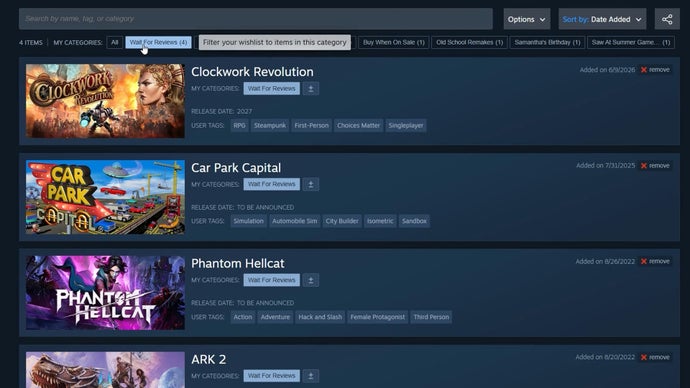
Valve is making a long-overdue upgrade to one of Steam's most beloved — and most chaotic — features. The Steam wishlist, a digital holding pen for games players intend to buy someday, is finally getting category support, allowing users to sort their queued titles into custom groups rather than keeping everything in one sprawling, unmanageable list. For anyone who has accumulated hundreds of entries over the years, this is a significant usability win. The change was surfaced by gaming outlets monitoring Steam's ongoing feature development, with the update appearing to roll out gradually across the platform.
The wishlist has long been a cornerstone of how PC gamers interact with Steam's storefront. Players use it not just for personal tracking, but to alert themselves to sales, price drops, and new releases — Steam sends notifications when wishlisted games go on discount, making the list a practical shopping tool as much as a personal collection log. However, without any organizational structure, a wishlist containing dozens or hundreds of titles quickly becomes unwieldy and difficult to parse meaningfully. Valve's decision to introduce categories suggests the company has been listening to feedback from its community.
With the addition of categories, users will presumably be able to create custom labels — think 'Day One Purchases,' 'Wait for Sale,' 'Multiplayer with Friends,' or genre-based groupings — giving the wishlist genuine utility as a planning tool rather than just a dumping ground. This kind of structured organization is something rival platforms and game library managers have offered for some time, so Steam's implementation brings its wishlist feature closer to parity with third-party solutions like Backloggd or GG.deals.
The timing of the update is notable. Steam has been steadily modernizing its interface and feature set over the past couple of years, rolling out improvements to the mobile app, library organization, and discovery tools. Adding wishlist categories fits neatly into that broader pattern of incremental but meaningful quality-of-life enhancements. For developers and publishers, wishlist numbers remain a critical metric for gauging pre-launch interest, and a better-organized wishlist could encourage players to engage more actively with their queues rather than letting titles languish.
No firm rollout date has been confirmed for all users, and it remains to be seen exactly how granular the category system will be at launch. Valve has a habit of quietly shipping features and expanding them over time based on user adoption and feedback. Players eager to try the new system should keep an eye on their wishlist interface for updates appearing in the coming days and weeks.
The bigger picture
Steam's wishlist category update might seem like a minor housekeeping feature, but it actually speaks to something more significant about how Valve approaches its platform. For years, Steam has been criticized for a 'good enough' philosophy — features that function but rarely feel polished or thoughtfully designed. The wishlist was a prime example: powerful in concept, messy in execution. Introducing categories signals that Valve is genuinely investing in the user experience layer of Steam, not just its backend infrastructure or storefront revenue mechanics.
From a competitive standpoint, this matters because Epic Games Store and other platforms have been trying to chip away at Steam's dominance partly by offering cleaner, more modern interfaces. While none have succeeded in meaningfully denting Steam's market share, the pressure has clearly nudged Valve toward more frequent UX improvements. A better wishlist isn't going to make or break platform loyalty, but it's one more reason for users to feel that Steam actively earns their continued preference rather than coasting on network effects alone.
What readers should watch is whether Valve layers additional functionality onto this foundation — smart sorting, collaboration features, or integration with Steam's recommendation engine could transform the wishlist from a passive list into an active discovery and planning tool. There's also an interesting angle for developers: if players can better organize their wishlists, they may be more likely to convert on sale notifications for titles they've deliberately flagged as priorities. That could have subtle but real implications for indie developers who rely heavily on wishlist-driven sales spikes.
We're covering this one because the Steam wishlist is genuinely one of gaming's great unsung features — quietly used by tens of millions of players every day, yet rarely discussed with the attention it deserves. Here at LagPing, we think quality-of-life improvements deserve as much coverage as the big game announcements, because they shape how people actually experience gaming on a daily basis. This update might not make headlines the way a AAA release does, but for anyone who's ever stared helplessly at a 400-game wishlist wondering where to even begin, it's a meaningful change. We also think it's worth tracking how Valve continues to quietly evolve Steam in 2024 and beyond — the platform's incremental improvements tell a story about where PC gaming is heading that's easy to miss if you're only watching for the splashy stuff.
As an Amazon Associate, LagPing earns from qualifying purchases. Product links are affiliate links.
You might also like
Valve Overhauls Steam Wishlists and Gifting With Cross-Region Support and Custom Categories
Jul 24

Claude Gets a Smarter Voice Upgrade — and It Can Actually Use Your Apps
Jul 24

iOS 27 Bets on Speed and Smarter Siri Over Flashy New Features
Jul 14

2007 FromSoftware Prototype Reveals Demon's Souls Once Let Players Switch to First-Person View
18h ago