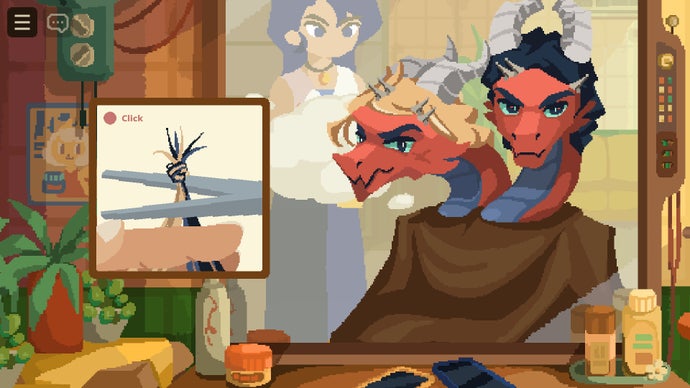
Beastfolk Barber Turns Salon Anxiety Into a Demon-Deal Worldbuilding Adventure
Key takeaways
- Beastfolk Barber is an indie hairstyling game set in a fantasy world of anthropomorphic animal characters.
- Players operate under a demonic contract, adding narrative tension to the cozy salon gameplay loop.
- Worldbuilding unfolds through individual client interactions rather than traditional cutscenes or exposition.
Beastfolk Barber is an upcoming indie title that puts players behind the stylist's chair in a fantasy world populated entirely by anthropomorphic animal characters — and there's a demon deal quietly looming over every snip and trim. The game's central premise sounds deceptively lighthearted: you run a barbershop, you cut hair, you make customers happy. But the mechanics and narrative layered beneath that setup suggest something considerably more ambitious than a simple salon simulator. Each client who walks through the door carries their own backstory, cultural identity, and emotional weight, making every appointment feel like a short story in miniature. The worldbuilding emerges organically through these interactions rather than through exposition dumps or cutscenes, which is a genuinely refreshing structural choice for the genre. Players must read social cues, manage expectations, and navigate the personalities of a wildly varied clientele — all while keeping whatever bargain they struck with their demonic benefactor in good standing. The haircutting itself functions as a tactile, skill-based mechanic that rewards attention and care, echoing the real-world anxiety that surrounds something as seemingly mundane as sitting in a stylist's chair. That emotional authenticity — the vulnerability of handing someone scissors and trusting them with your appearance — is clearly a deliberate design touchstone for the developers. Early previews suggest the game walks a careful tonal line, balancing cozy aesthetic warmth with genuine narrative stakes that give players a reason to keep coming back beyond the novelty of cutting furry ears and styled tails.
The bigger picture
Beastfolk Barber arrives at a moment when the cozy-game market is both thriving and becoming increasingly crowded, which means standing out requires more than pleasant visuals and a calm soundtrack. What appears to differentiate this title is its commitment to using a service-job framework — one already popularized by games like Coffee Talk and Unpacking — as a genuine storytelling engine rather than a backdrop. Rivals in this space often treat worldbuilding as wallpaper; Beastfolk Barber seems to treat it as the actual product. The demonic contract angle introduces a layer of tension that prevents the experience from settling too comfortably into pure relaxation, which is a smart risk. It gives the narrative somewhere to go and raises questions players will want answered. For indie developers watching this space, the game signals that niche premises executed with genuine craft can punch well above their marketing budgets — the concept alone generates curiosity without requiring a massive reveal trailer. The anthropomorphic character design also broadens appeal across audiences who might not identify with typical fantasy archetypes, tapping into a fandom community that has historically been underserved by mainstream game releases. Whether the final product delivers on its early promise will depend heavily on the writing quality sustaining itself across a full playthrough.
We wanted to cover Beastfolk Barber because it represents exactly the kind of creative swing that gets lost in a news cycle dominated by AAA sequels and platform wars. At LagPing, we think the most interesting conversations in gaming right now are happening in the indie space, where designers are actually experimenting with what a game can be about. A hairstylist simulator built around emotional vulnerability and demonic bargains is precisely the kind of premise that deserves more than a one-line mention. We're also genuinely curious how the worldbuilding holds up over a full session — does the charm sustain, or does the novelty thin out? That's the real question for cozy games trying to offer depth. We'll be watching this one closely as more gameplay surfaces.
As an Amazon Associate, LagPing earns from qualifying purchases. Product links are affiliate links.
You might also like

GTA 6 Turns a 16-Year-Old Internet Legend Into Core Gameplay
Oct 29

Amazon's $98 Billion Anthropic Bet Dwarfs VC Returns in IPO Windfall
Oct 28

Tokyo Cafe Turns Viral Indie Hit into Playable Experience—with Cocktails
Oct 27

Google Turns Gemini Into a Shopping Checkout in India, Starting With Flipkart
Sep 27