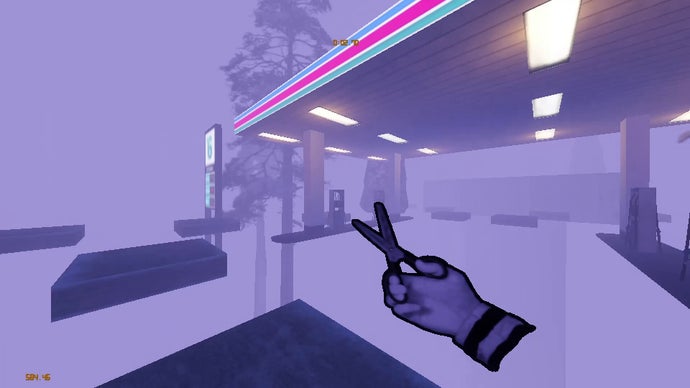
Clipmatrix Turns Counter-Strike's Accidental Movement Tech Into a Full Platformer
Key takeaways
- Clipmatrix is a first-person platformer built around Source Engine bunny hopping as an intentional core mechanic.
- Bunny hopping originated as an unintended physics exploit in games like Counter-Strike, not a designed feature.
- The game is set in surreal industrial environments and targets players who enjoy mastery-driven movement systems.
Clipmatrix is a momentum-driven platformer that takes one of PC gaming's most famous unintended mechanics — bunny hopping from Valve's Source Engine — and rebuilds it as a deliberate, central gameplay system. Rather than treating the technique as an exploit to be patched out, the developers have engineered an entire game around its rhythm and feel, setting the action across surreal, industrial environments that demand precise movement to navigate. The announcement has drawn attention from both the platformer community and Counter-Strike veterans who spent years perfecting the technique in competitive play.
Bunny hopping in Source Engine games like Counter-Strike: Global Offensive and its successor CS2 is not an officially designed mechanic. It emerged from how the engine handles player momentum when jumping at precise intervals, allowing skilled players to maintain or even build speed beyond normal running limits. Over decades, it became so embedded in the competitive scene that whole communities formed around movement servers dedicated purely to practicing it — a testament to how deeply an unintended quirk can shape a game's culture.
Clipmatrix joins a small but interesting lineage of games that have taken accidental mechanics from other titles and rebuilt them as intentional features. The comparison to wavedashing in Super Smash Bros. Melee is instructive here: that exploit, born from animation canceling, became so essential that top-level play is essentially impossible without it, and several platform fighters since have deliberately incorporated similar mechanics. Clipmatrix appears to be taking the same philosophy and applying it to the first-person platforming space.
Details on the developer and a firm release window remain limited at this stage, but the footage shown highlights fluid, fast movement through environments that blend industrial architecture with more abstract, dreamlike visual design. The aesthetic choice makes sense for a game built on a mechanic associated with concrete server rooms and dusty mid-2000s map design — there is clearly an intent to push the visual language somewhere unexpected while keeping the kinetic feel familiar to Source veterans.
For players who have never touched Counter-Strike, Clipmatrix may serve as an accessible entry point into movement mechanics that have historically required hundreds of hours of practice to feel natural. By structuring a platformer around these systems from the ground up, the developers have the opportunity to build proper tutorials and progression curves that competitive shooters never needed to provide.
The bigger picture
What makes Clipmatrix genuinely interesting from an industry perspective is the question of audience crossover. Counter-Strike's movement community is passionate but niche, largely self-taught through community servers and YouTube tutorials rather than anything Valve ever formally supported. A standalone platformer that codifies these mechanics could either pull that audience in immediately or alienate them by making accessible something they prized for its difficulty and exclusivity. That tension is worth watching as more gameplay surfaces.
On the competitive side, this positions Clipmatrix in an adjacent space to games like Titanfall 2 and Ghostrunner, both of which built dedicated followings by centering fluid, skill-expressive movement in non-traditional contexts. If the level design holds up and the feel translates well outside a shooter context, there is a genuine market here — speedrunning communities in particular tend to gravitate hard toward games built around momentum physics. Developers at studios like Respawn proved there is appetite for mastery-driven movement; the question is whether a smaller team can execute with the same polish.
Regulators and platform holders are not likely factors here, but the broader creative signal is worth noting: the most interesting independent game concepts right now are frequently coming from designers who look at the gaps and glitches in beloved games and ask what a title designed around those moments would feel like. That instinct has produced some of the decade's most memorable releases, and Clipmatrix looks like a genuine attempt rather than a novelty pitch. Watch for hands-on impressions and a confirmed release platform as the clearest signal of whether this will convert curiosity into a real player base.
We flagged Clipmatrix because it represents something we genuinely enjoy covering at LagPing: a concept that makes you stop and think 'why hasn't anyone done this properly before?' Bunny hopping has been a fixture of PC gaming culture for over two decades, living in a weird space between exploit and art form, and the idea of a game that treats it as the foundation rather than the footnote is legitimately exciting. It also connects to a wider conversation happening right now about where innovative movement design is coming from — increasingly, the answer is small teams looking at the edges of existing games rather than large studios iterating on proven formulas. We'll be keeping a close eye on Clipmatrix as more details emerge, and we think anyone who has spent time on movement servers or watched Surf and KZ videos knows exactly why this has potential.
As an Amazon Associate, LagPing earns from qualifying purchases. Product links are affiliate links.
You might also like

Proto Man Returns as Dual Override's Second Playable Character with Aggressive Close-Range Combat
6d ago

Team Ninja's Samurai Soulslike Returns March 2027 With Day-One Game Pass Access
Sep 16

Pokémon Returns to Theaters with Card Game-Focused Film in 2027
Aug 31

EA Turns Iron Man Leak Into Viral Win With Cheeky Response
Aug 30