
Half-Vampire, 30-Day Clock: Rebel Wolves Reveals How Choice Really Works in Dawnwalker
Key takeaways
- Time only advances in The Blood of Dawnwalker when players commit to specific choices, dividing each in-game day into 8 finite segments
- Protagonist Coen becomes a sunlight-resistant half-vampire, giving him unique power in a world ruled by the vrakhiri with a 30-day countdown to save his family
- The Blood of Dawnwalker launches on PlayStation 5 on September 3, 2026, published by Bandai Namco Entertainment
Rebel Wolves, the studio founded by former CD Projekt Red veterans, has offered a deep narrative walkthrough of The Blood of Dawnwalker, its upcoming dark-fantasy RPG set in a plague-ridden medieval world dominated by vampires known as the vrakhiri. The studio's latest breakdown centers on protagonist Coen, a young farmer whose life is violently upended during a single catastrophic night, and the remarkable player agency system that governs everything that follows. The game is set for release on PlayStation 5 on September 3, 2026, published by Bandai Namco Entertainment.
The game opens with Coen and his family trapped in the village of Laslea under vampire occupation. The vrakhiri, led by the ruthless Knyaz Brencis, demand a regular blood tribute from the villagers in a ritual called the Blood Mass. What makes The Blood of Dawnwalker structurally distinctive is how it handles time: the day is divided into eight discrete segments, and time only advances when the player actively commits to an action. While Coen wanders, observes, and explores, the sun remains frozen in the sky — only decisive choices move the story forward toward nightfall and its consequences.
This system creates genuine tension between exploration and narrative momentum. Players can pursue side stories — helping a weaver recover a stolen tapestry, confronting a suspicious stranger by the river, seeking medicine for an ailing family member, or even uncovering the seeds of an uprising — but the day's limited segments mean not every thread can be resolved. Rebel Wolves is explicit that some outcomes lie beyond the player's control entirely. No set of choices can prevent the Blood Mass from occurring once night arrives, and grief, fear, and revenge operate on their own momentum regardless of how the player intervenes.
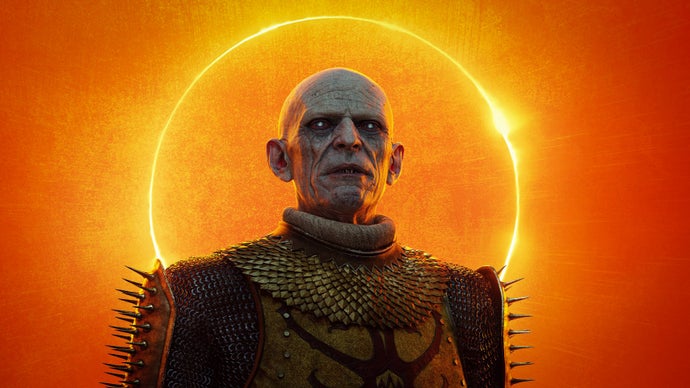
After the Blood Mass ends in disaster, Coen is transformed by Brencis into a half-vampire — a weapon intended to terrorize his own community. Yet the transformation backfires: Coen retains the emotional depth of his humanity while gaining vampiric power, and crucially, he can withstand sunlight, something the vrakhiri cannot control. This makes him a genuinely singular entity in the world. His surviving family is imprisoned with thirty days until they become sacrifices at Brencis's coronation, establishing the game's central ticking clock and the stakes of every subsequent decision.
From that point, Vale Sangora opens up as a narrative sandbox. Coen can pursue revenge against the vrakhiri, join a brewing revolution, or chart an entirely self-interested path through the valley. Rebel Wolves appears to be leaning hard into the idea that meaningful choice requires real loss — the day-segment system ensures players can never do everything, while the 30-day macro-countdown keeps the broader stakes from ever fading into background noise. It is a design philosophy that promises to make every playthrough feel genuinely personal.
The bigger picture
What Rebel Wolves is attempting with The Blood of Dawnwalker is a meaningful structural answer to one of open-world RPG design's thorniest problems: how do you make time feel real when the player can simply wander indefinitely? Most games in this space, from The Witcher 3 to Baldur's Gate 3, resolve this by making urgency entirely optional — critical quests wait patiently while the player picks flowers and plays card games for fifty hours. Dawnwalker's freeze-frame time system is a genuine design gamble, wagering that players will feel more invested in a world that actually pushes back against their indecision.
The competitive implications are interesting. Rebel Wolves is a relatively young studio going up against established juggernauts, but this kind of distinctive mechanical identity could be exactly what carves out a loyal audience. Players who felt that recent narrative RPGs were either too consequence-free or too railroaded may find Dawnwalker's middle path — meaningful limits without total determinism — genuinely compelling. The 30-day countdown framing draws obvious comparisons to The Legend of Zelda: Majora's Mask, a game beloved precisely because its time pressure made the world feel alive rather than static.
The risks are real, however. A system that explicitly tells players some outcomes are beyond their reach can feel either profound or deeply frustrating depending on execution. Rebel Wolves will need to ensure that the moments of lost control read as narrative tragedy rather than design failure. The September 2026 window gives the studio time, but it also places Dawnwalker in a crowded release landscape. Watch for how early previews respond to the pacing of the time-segment system — that will be the clearest signal of whether this ambitious structure translates into something players actually want to live inside.
We've been keeping a close eye on The Blood of Dawnwalker since Rebel Wolves first announced the project, and this latest deep dive into its quest and time mechanics is exactly the kind of design-forward storytelling we love to dig into at LagPing. The founding pedigree of this studio — many of its key figures shaped The Witcher 3 — means there's a baseline of craft credibility here that makes every design decision worth taking seriously. But beyond the studio's resume, what strikes us about Dawnwalker is that it's genuinely trying to solve a problem. Time-based choice systems are rare in big narrative RPGs, and rarer still are studios willing to publicly commit to the idea that players won't be able to do everything. That's a bold promise in an era when most publishers compete on the size and density of their open worlds rather than the meaningfulness of their constraints. We think this conversation about what player agency actually means — and what makes a choice feel real — is one of the most important discussions happening in gaming right now, and Dawnwalker is putting itself at the center of it. That's why this story is on our front page.
As an Amazon Associate, LagPing earns from qualifying purchases. Product links are affiliate links.
You might also like

Citizen's Star Wars Chronographs Drop 45% at Jomashop—Eco-Drive Tech Meets Rebel Flair
Sep 12

Roku Launches Around-the-Clock AI Content Channel Amid Growing FAST Debate
Aug 8

Wikipedia's Parent Organization Faces Growing Worker Rebellion as US Staff Demand Recognition
Jul 29
Rebel Wolves Confirms Blood of Dawnwalker Disc Contains Full Game Data Amid Physical Media Fears
Jul 19