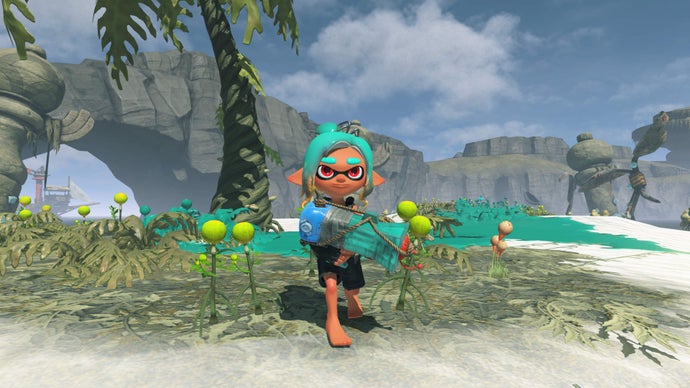
How Splatoon Raiders Ditched Trap Forts for Non-Stop Combat Chaos
Key takeaways
- Splatoon Raiders originally featured trap-placement base defence mechanics before a complete design overhaul prioritised active, fast-paced combat.
- Developers scrapped the early concept because it made players feel like passive spectators, which clashed with Splatoon's core identity of kinetic, movement-driven action.
- Nintendo positioned Raiders as a spin-off rather than Splatoon 4, explicitly preserving the competitive multiplayer direction for the mainline series.
Splatoon Raiders arrives on Nintendo Switch 2 on July 23rd, and ahead of its launch Nintendo published an unusually candid developer interview — 'Ask the Developer Vol. 22' — featuring producer Seita Inoue, director Yoshihiko Ito, art director Koji Sonoyama, and sound director Shu Tamura. The conversation goes well beyond marketing talking points, giving fans a genuine window into the game's turbulent creative journey from concept to finished product. It is a striking departure from the polished, risk-free PR interviews that typically accompany big Nintendo launches.
The most surprising revelation is just how different Splatoon Raiders originally looked. Early development centered on a trap-placement mechanic where players would scatter defences across the environment and then hold their position alongside those structures. Director Ito confirmed this directly, stating that the first prototype was built around 'placing traps all over the place and to fight alongside them,' with a shared early development video posted alongside the article to illustrate exactly how that version felt. It was a logical instinct — Salmon Run, the beloved co-op mode in Splatoon 2 and 3, already leans heavily into wave-defence territory — but the team found the execution fell flat.
The problem, as the developers saw it, was passivity. Players were effectively constructing an elaborate fortress and then spectating its performance rather than actively driving the action themselves. That dynamic stripped out the kinetic energy that has always separated Splatoon from its competitors. Inoue pointed back to the franchise's roots on Wii U, describing how the original game's appeal was rooted in 'the sense of unity between the player and the character through gyro controls on the Wii U GamePad, combined with the ink-shooting mechanics.' Losing that feeling, even in a spin-off context, was deemed unacceptable.
The pivot that followed reshaped the entire design philosophy. Rather than fortifying positions, the team rebuilt the game around expanding player mobility and offensive options, introducing a gadget system that grants new abilities and dramatically changes how players engage with enemies and traverse levels. The result is a PvE loop explicitly designed to sustain tens of hours of play through weapon progression, varied loot, escalating boss encounters, and repeatable mission structures. Ito described the long-term goal as turning players into 'the ultimate multitasker' — someone simultaneously managing movement, weapons, gadgets, and enemies at speed.
Inoue was also careful to clarify that Raiders exists as a deliberate spin-off rather than a mainline sequel, stressing that 'competitive gameplay' remains the heart of the core series and will continue to be developed going forward. Eurogamer awarded the finished game four stars, describing it as 'a hectic, often overwhelming delight,' which suggests the pivot from passive fortress-building to aggressive, ability-driven combat paid off. Whether Raiders finds its audience among both Splatoon veterans and newcomers to the franchise will become clearer in the weeks following its launch.
The bigger picture
The creative arc of Splatoon Raiders is a useful case study in how a single design instinct — passivity versus agency — can determine whether a game feels alive or inert. The trap-defence concept was not inherently a bad idea; tower defence and hybrid PvE mechanics have fuelled enormously successful games for years. The issue was context. Splatoon's identity is inseparable from movement, momentum, and the constant physical expression of painting, jumping, and swimming through ink. Any mechanic that encourages players to stop and watch inevitably works against that identity, no matter how strategically satisfying it might be in isolation.
The decision to frame Raiders as a spin-off rather than Splatoon 4 is also strategically significant. Nintendo is clearly aware that the competitive Splatoon community has expectations about what a numbered sequel should deliver — ranked modes, fresh maps, meta evolution — and a PvE-focused departure would likely have been received with mixed feelings in that context. By labelling it a spin-off, Nintendo buys creative freedom while protecting the mainline brand. It is a model the company has used successfully before, and it signals that the internal teams see genuine long-term potential in non-competitive Splatoon experiences without wanting to redefine what the main series stands for.
What readers should watch going forward is whether Raiders' looter shooter loop has genuine staying power. The developers have articulated a compelling vision for player progression and replayability, but the genre is notoriously difficult to sustain — even major studios with dedicated live service infrastructure have struggled to keep PvE loot games populated months after launch. Nintendo does not have a strong track record with long-form content support of this kind. Whether Raiders gets meaningful post-launch updates, seasonal content, or new mission types will ultimately determine if it becomes a lasting franchise pillar or an interesting experiment.
We decided to cover the Splatoon Raiders developer interview in depth because it is genuinely rare for Nintendo to be this open about design failure and creative pivoting. Most pre-launch coverage of Nintendo titles focuses on what the game is — we wanted to highlight the story of what it almost was, because that context meaningfully shapes how you understand the finished product. The shift from trap-laying tower defence to high-speed gadget combat is not a minor tweak; it is a fundamental rethink of the game's soul, and the fact that the team caught and corrected it before release is worth acknowledging. We also think the spin-off framing is an underreported story in itself — Nintendo is quietly experimenting with expanding its biggest franchises into new genres while carefully protecting the core experiences fans expect. That's a creative strategy with real implications for where Splatoon, and potentially other Nintendo IP, goes next. Keep an eye on this one.
As an Amazon Associate, LagPing earns from qualifying purchases. Product links are affiliate links.
You might also like

Listen Labs ditched $1.5B funding to pursue Salesforce mega-deal
Sep 10

Arc Raiders Expeditions Frozen Until 2027 as Embark Admits Core Systems Need a Rethink
Aug 22

Undead Labs Cuts Staff After Xbox Split, Promises State of Decay 3 Stays on Track
22h ago

Marvel's Wolverine Director: Height Matters When Building Emotional Depth
22h ago