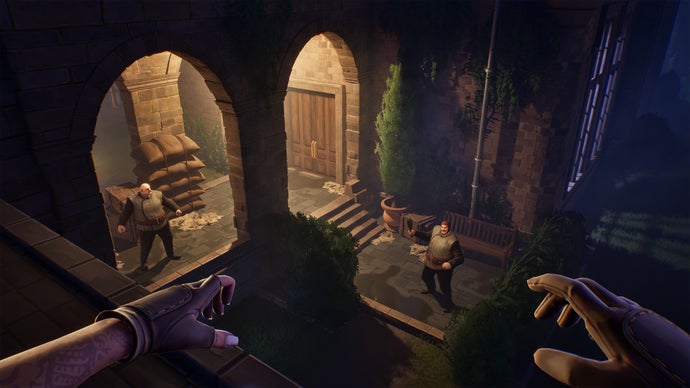
OtherSide Entertainment Pledges Offline Survival for Thick as Thieves After Studio Layoffs
Key takeaways
- OtherSide Entertainment confirmed layoffs following Thick as Thieves' underwhelming commercial launch
- The game was scaled back from competitive multiplayer to solo and co-op before release
- Despite studio struggles, OtherSide has committed to keeping the game playable long-term
OtherSide Entertainment's Thick as Thieves has had a turbulent journey from concept to launch, and the road hasn't smoothed out since release. The game, which was first revealed over two years ago, captured some early excitement with a genuinely fresh mechanical hook: a multiplayer immersive sim where players would compete against one another for the same loot in real time. It was an ambitious pitch in a genre not exactly known for competitive multiplayer, and for a while it looked like OtherSide might carve out a unique niche.
That ambition took its first hit earlier this year when the multiplayer component was quietly dropped ahead of launch, leaving players with solo and co-op options only. While co-op immersive sims remain a rarity — which is itself something of a selling point — the downgrade from the original vision disappointed a portion of the audience that had been following development. The shift raised questions about the game's scope and whether the studio had encountered serious development difficulties.
Those concerns appear to have been warranted. Following the game's commercial launch, OtherSide Entertainment confirmed a round of layoffs affecting a meaningful portion of its team. The cuts strongly suggest that Thick as Thieves did not perform at the level needed to sustain the studio's workforce, a grim but increasingly familiar story in the current games industry climate where even modestly ambitious titles struggle to find their audience.
Despite the difficult circumstances, the remaining staff at OtherSide have delivered at least one meaningful commitment to their player base: the game will not be rendered unplayable. In an era when live-service titles and online-dependent games regularly vanish entirely when studios shut down or cut support, this pledge carries real weight. Players who purchased Thick as Thieves will retain a functional product, which is more than many studios have offered in comparable situations.
The broader context here is important. The games industry has seen a string of high-profile closures and abandonments in recent years, with titles becoming inaccessible overnight when servers go dark or licensing deals expire. OtherSide's decision to prioritize long-term playability — even in the face of financial strain — sets a quiet but notable example of developer responsibility toward their community.
The bigger picture
The story of Thick as Thieves reads as a near-perfect case study in the brutal economics of mid-tier game development. The original vision — a competitive multiplayer immersive sim — was genuinely exciting precisely because it occupied a gap in the market that major publishers have largely ignored. OtherSide wasn't trying to clone an existing formula; they were attempting something structurally novel. That ambition, however, appears to have outpaced what the studio could sustainably deliver, and the pivot to co-op suggests development realities caught up with the concept well before launch.
What's particularly striking is the post-launch commitment to preservability. The gaming industry has a deeply uncomfortable relationship with legacy access. When a studio stumbles financially, the first casualties are often the players themselves, who find purchased products quietly going dark. OtherSide's pledge to keep Thick as Thieves playable is a small but genuine act of accountability — one that triple-A publishers with far greater resources have routinely failed to match. It won't save the studio's fortunes, but it does protect the people who believed in the project enough to buy it.
For the wider industry, this moment should prompt an uncomfortable question about who bears responsibility when games fail. Developers, publishers, and platform holders all profit from sales but rarely share the long-term cost of preservation. Watching a small, clearly struggling studio do what larger operations refuse to do only sharpens that irony. Readers should watch whether any industry-wide conversation around game preservation gains traction in the months ahead, particularly as more studios face similar fates in an increasingly unforgiving market.
We're covering Thick as Thieves not because it's a blockbuster story, but because it represents something we think deserves more attention: the human and creative cost of ambitious game development gone sideways, and what studios owe their communities when things fall apart. OtherSide Entertainment tried something genuinely interesting, encountered the kind of obstacles that are reshaping the entire mid-tier development landscape, and still managed to do right by its players in a way that many far wealthier operations have not. At LagPing, we believe that game preservation and developer accountability are part of the same conversation, and that conversation is becoming more urgent as closures and server shutdowns pile up. This story sits at the intersection of industry economics, creative ambition, and player rights — all themes we return to regularly because they shape what gaming looks like for everyone. We want our readers thinking not just about what games exist today, but whether they'll still exist tomorrow.
As an Amazon Associate, LagPing earns from qualifying purchases. Product links are affiliate links.
You might also like

Safety Pledges or Market Theater? AI Leaders Dodge the Slowdown Question
3d ago

Fan Revolt Forces EA to Gut College Football 27's Offline Monetization Within Days of Launch
Jul 11

Undead Labs Cuts Staff After Xbox Split, Promises State of Decay 3 Stays on Track
1d ago

Marvel's Wolverine Director: Height Matters When Building Emotional Depth
1d ago