Season 4 Turns Battlefield 6 Into a Top Gun Playground With Real Jets, Carrier Warfare, and Two-Seaters
Key takeaways
- Season 4 introduces Battlefield 6's first two-seater jets, a series first since Battlefield 2, tied to the Top Gun crossover in Phase Two
- The revamped Carrier Strike mode requires coordinated land, air, and sea combat to sink enemy carriers, going well beyond its Battlefield 4 predecessor
- Quality-of-life additions including custom lobbies, admin controls, and Spectator Mode debut across the season to support competitive and community play
Battlefield 6 is gearing up for what could be its most content-packed season since launch, with Season 4 officially kicking off on July 21st across PC, PlayStation 5, and Xbox Series X/S. Battlefield Studios has laid out an ambitious three-phase roadmap that spans nearly two months, touching on naval warfare, a major franchise crossover, new maps, and long-requested community features. The announcement follows an earlier teaser of naval combat mechanics that had already generated significant buzz among the game's growing player base.
The first phase, dubbed Pacific Front, centers on Tsuru Reef — the largest map in Battlefield 6 to date and also the first to incorporate naval combat. Two water vehicles debut here: the RCB-90 Patrol Boat and the RHIB light transport. Three new weapons also arrive in Phase One, including the Bren 3 Carbine, EF88 Assault Rifle, and a uniquely versatile VSSM DMR capable of switching to full-auto fire. This opening salvo sets a tone of scale and variety that the rest of the season builds upon.
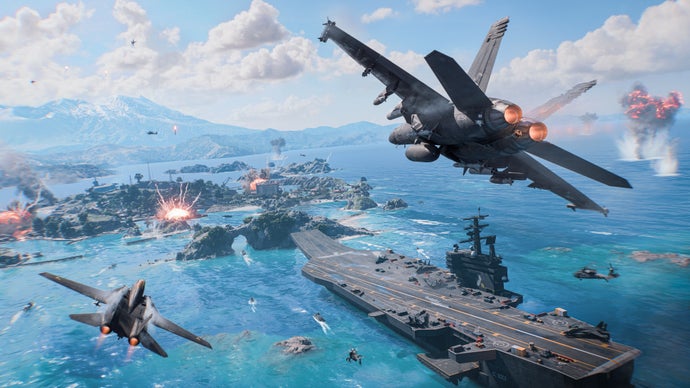
Phase Two, beginning August 18th, is where the headline-grabbing Top Gun crossover fully materializes. A reimagined Wake Island map launches alongside two aircraft carriers, one for each team, echoing the beloved Battlefield 4 layout while adding modern scale. The F-74A Seacat (inspired by the real-world F-14 Tomcat) and the F/A-81F Super Spectre (based on the F/A-18 Super Hornet) become the game's first two-seater jets, a first for the Battlefield series since Battlefield 2 over two decades ago. The long-range Desert Tech HTI Sniper Rifle also joins the arsenal during this phase.
The Top Gun tie-in goes well beyond cosmetics by introducing Carrier Strike, a spiritual successor to Battlefield 4's beloved Carrier Assault mode. Teams must coordinate land, air, and sea operations to destroy the enemy's carrier — a significantly more complex version of the original objective. Carrier Strike is positioned as a limited-time mode set within the Top Gun universe, complete with film-authentic voice-overs and characters. An additional air-only mission called Fighter Sweep will appear in Gauntlet, part of the free-to-play Redsec offering.
Phase Three, titled Tidal Strike, arrives September 15th but remains largely under wraps for now. Season-wide improvements are also confirmed, including custom lobbies, Portal pre-lobby team assignment tools, admin controls for community organizers, and a long-awaited Spectator Mode launching first in Conquest and Redsec battle royale. These additions signal that Battlefield Studios is actively listening to its competitive and community-event-focused audience, layering meaningful infrastructure on top of an already well-received live-service game.
The bigger picture
The Top Gun collaboration stands out as a case study in how to do a franchise crossover properly. Rather than slapping movie branding onto existing in-game assets, Battlefield Studios has built genuine mechanical content around the license — two-seater jets that change how air combat plays, a new mode with thematic coherence, and mission content that fits naturally within existing modes. For a game that has occasionally been criticized for leaning too heavily on spectacle, this is a meaningful step toward substantive crossover design.
The return of two-seater jets is arguably the most significant gameplay development buried inside all this seasonal content. Battlefield 2 defined a generation of multiplayer gaming partly because of pilot-gunner cooperation in aircraft, and its absence from the series has been a quiet but persistent complaint for years. Reintroducing that dynamic — even tied to a limited-time mode initially — opens the door for deeper crew-based aerial play that could reshape how squads coordinate in future seasons and titles.
For EA and Battlefield Studios, Season 4 also represents a commercial inflection point. With Battlefield 6 already breaking series records and a strong launch behind it, this season needs to convert casual players into long-term ones. The quality-of-life additions like custom lobbies, admin controls, and Spectator Mode suggest the team is courting content creators and competitive organizers — a smart move that can dramatically extend a game's visibility and lifespan. Watch closely whether Carrier Strike's limited-time framing becomes permanent based on player reception.
We're covering Season 4 in depth because it genuinely feels like a turning point for Battlefield 6's post-launch identity. At LagPing, we pay close attention to how live-service games evolve past their honeymoon phase, and what Battlefield Studios is doing here — building real gameplay systems around a blockbuster IP rather than just selling a cosmetic bundle — is worth spotlighting. The return of two-seater jets is the kind of series-history moment that deserves more than a footnote, and we wanted to give it proper context. The quality-of-life improvements, particularly around community tools, also matter a great deal for the people who run tournaments and events. We'll be watching Phase Two's launch closely and will report back on whether Carrier Strike lives up to its ambitious pitch.
As an Amazon Associate, LagPing earns from qualifying purchases. Product links are affiliate links.
You might also like
Bellring Games Lays Out Mistfall Hunter's Season 1 Plan After One Million Players Join
1d ago

Quake Turns 30: Dawn of the Machine Brings 19 Free Levels Built With MachineGames
1d ago

Ted Lasso Season 4 Could Be the Boost Apple TV+ Needs in a Crowded Streaming Race
3d ago

Marvelous Severs Tencent Ties After Six Years, Killing Story of Seasons Mobile Plans
5d ago