Season 4's Tsuru Reef Is Battlefield 6's Most Ambitious Map — But Will Anyone Play It?
Key takeaways
- Tsuru Reef is Battlefield 6's largest map ever, launching as part of the Season 4 update.
- Despite strong design credentials, there are genuine concerns the map may struggle to hold regular server rotation presence.
- Player behavior in the coming weeks will be critical in determining whether the map becomes a lasting staple or an admired rarity.
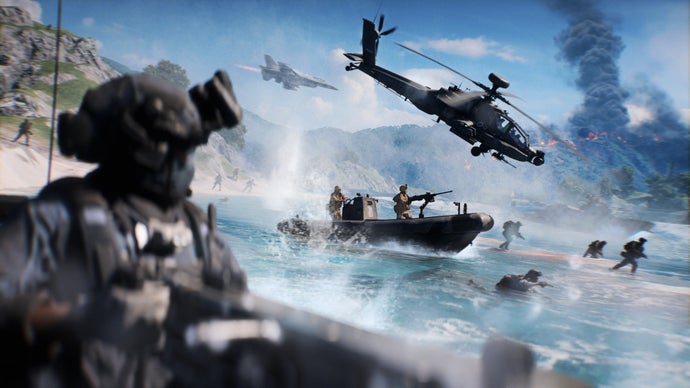
Battlefield 6's Season 4 brings with it Tsuru Reef, officially the game's largest map to date, and early impressions from preview access paint a picture of something genuinely ambitious. The map represents a clear creative swing from the development team — sprawling terrain, layered objectives, and a sense of scale that few multiplayer shooters dare to attempt. By almost every aesthetic and mechanical measure, Tsuru Reef is an impressive piece of design work that enriches the game's overall offering.
The concern, however, isn't about quality — it's about player behavior. Battlefield's community, like most long-running multiplayer shooter fanbases, tends to gravitate toward familiar favorites. Certain maps dominate server rotation queues precisely because players know their sightlines, vehicle spawns, and chokepoints by heart. A brand-new, sprawling map requires an investment of time and mental energy that not every session allows for, and that reality could quietly sideline Tsuru Reef despite its obvious strengths.
The analogy that has been floating around preview coverage is apt: Tsuru Reef is like the adventurous dish on a restaurant menu that diners always intend to try but rarely order when the moment arrives. It enriches the menu simply by existing, but its presence alone doesn't guarantee it'll get the attention it deserves. This is a dynamic the Battlefield franchise has wrestled with before, as sprawling combined-arms maps often lose server population battles against tighter, infantry-focused alternatives.
For Season 4, the map's arrival is still a net positive. It signals that the development team is continuing to invest meaningfully in post-launch content rather than coasting on the existing rotation. Tsuru Reef also opens up gameplay opportunities — longer engagements, vehicle coordination, and large-scale tactical play — that more compact maps simply cannot deliver. Whether the broader player base embraces those opportunities is a separate question entirely.
With the map going live alongside Season 4, the coming weeks will be telling. Server population data, community feedback on forums, and how often the map appears in rotation will all offer a clearer picture of whether Tsuru Reef becomes a beloved staple or an admired footnote in Battlefield 6's lifecycle. The hope is that players give it a genuine chance before retreating to comfort zones.
The bigger picture
The Tsuru Reef situation exposes a tension that lives at the heart of live-service game design: ambition and accessibility don't always coexist comfortably. Developers pour resources into large, complex maps because they showcase technical capability and offer experiences that smaller arenas cannot replicate. But the very scale that makes those maps impressive can also make them intimidating or exhausting for players who jump in for a quick session after work. The result is a paradox where the most ambitious content sometimes sees the least engagement.
From a competitive standpoint, this matters for Battlefield 6's long-term health. A map that rarely appears in active rotation — regardless of its design merit — struggles to justify the development cost that went into it. It also affects the player experience for those who actually want to engage with larger, more tactical gameplay styles. If Tsuru Reef becomes an occasional novelty rather than a rotation staple, it could quietly signal to the team that future resources should skew toward smaller, more immediately digestible content, gradually narrowing the game's identity.
What observers should watch over the next few weeks is player-driven data: are community servers and matchmaking queues actively selecting Tsuru Reef, or is it getting skipped? If engagement is low, the bigger question becomes whether the developers intervene with featured playlists, limited-time modes, or rotation weighting to surface it more prominently. How the studio responds to that challenge will reveal a lot about how seriously they intend to support their most ambitious creative swings going forward.
We decided to cover Tsuru Reef not just because it's the biggest Battlefield 6 map to date, but because it represents a genuinely interesting problem that affects nearly every live-service game in the market right now. The question of how studios keep bold, ambitious content relevant in an ecosystem shaped by player comfort and habit is one we think about a lot here at LagPing. Battlefield has always been at its best when it commits to large-scale, combined-arms chaos, and Tsuru Reef seems built with that philosophy front and center. But we've seen this story before — stunning new maps that quietly fade from rotation as players drift back to what they know. We wanted to give that conversation the space it deserves, because it speaks to the broader challenge of sustaining a live game beyond its launch window. Season 4 is a real moment for Battlefield 6, and how the community receives Tsuru Reef will shape the conversation around the game for months to come.
As an Amazon Associate, LagPing earns from qualifying purchases. Product links are affiliate links.
You might also like
Bellring Games Lays Out Mistfall Hunter's Season 1 Plan After One Million Players Join
1d ago

Ted Lasso Season 4 Could Be the Boost Apple TV+ Needs in a Crowded Streaming Race
3d ago
Marvelous Severs Tencent Ties After Six Years, Killing Story of Seasons Mobile Plans
5d ago

EA's $38M CEO Windfall Spotlights the Cost of Battlefield's Biggest Win
Jul 30